
Il verbo in inglese è una delle parti fondamentali della frase perché permette di esprimere un’azione, uno stato, una condizione o un avvenimento. Per imparare correttamente la grammatica inglese è importante conoscere le principali forme del verbo e capire quando devono essere utilizzate.
Tra le prime forme verbali da studiare troviamo l’infinito (infinitive), il gerundio (gerund) e il presente indicativo, che in inglese corrisponde principalmente al Present Simple.
In questa guida vedremo queste tre forme passo dopo passo, attraverso regole, tabelle ed esempi, con un linguaggio adatto agli studenti della scuola superiore.
- Guarda anche: Pronomi personali, verbo essere e aggettivi in inglese
Che cos’è il verbo in inglese
Come in italiano, il verbo indica generalmente un’azione, uno stato o una condizione.
Per esempio:
- to run = correre
- to study = studiare
- to sleep = dormire
- to be = essere
- to have = avere
- to know = sapere/conoscere
In inglese, però, la coniugazione dei verbi è generalmente molto più semplice rispetto all’italiano.
Pensiamo al verbo italiano parlare:
- io parlo
- tu parli
- lui parla
- noi parliamo
- voi parlate
- loro parlano
In inglese, con to speak, abbiamo:
- I speak
- you speak
- he/she speaks
- we speak
- you speak
- they speak
Come possiamo vedere, quasi tutte le persone utilizzano la stessa forma del verbo.
L’infinito in inglese: Infinitive
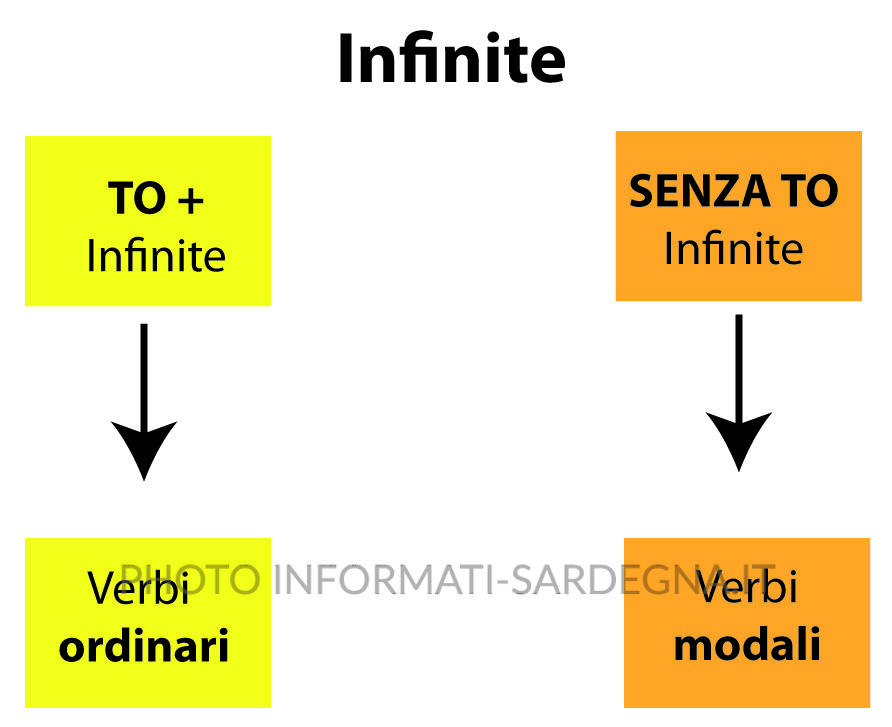
L’infinito è la forma base del verbo. In inglese possiamo incontrare principalmente due forme:
- to + verbo
oppure semplicemente:
- verbo senza to
La forma con to viene chiamata full infinitive o to-infinitive, mentre quella senza to viene chiamata bare infinitive.
- full infinitive → infinito pieno (col “to”)
- bare infinitive → infinito nudo
Esempi
| Inglese | Italiano |
|---|---|
| to be | essere |
| to have | avere |
| to go | andare |
| to eat | mangiare |
| to study | studiare |
| to play | giocare |
| to work | lavorare |
| to sleep | dormire |
Per esempio:
I want to study English.
Voglio studiare inglese.
In questa frase:
- want = voglio
- to study = studiare
Quando si usa l’infinito con “to”
L’infinito con to viene utilizzato in diverse situazioni. Una delle più comuni è dopo determinati verbi.
Per esempio:
I want to eat.
Voglio mangiare.
She wants to study.
Lei vuole studiare.
We decided to leave.
Abbiamo deciso di partire.
Alcuni verbi frequentemente seguiti dall’infinito con to sono:
- want = volere
- need = avere bisogno
- decide = decidere
- hope = sperare
- plan = pianificare
- learn = imparare
- try = cercare/provare
- promise = promettere
Esempio:
They decided to go home.
Hanno deciso di andare a casa.
L’infinito senza “to”
In alcuni casi utilizziamo la forma base del verbo senza to.
Questo accade, per esempio, dopo molti verbi modali, come:
- can
- could
- must
- should
- may
- might
- will
- would
Per esempio:
I can swim.
So nuotare.
Non diciamo:
I can to swim. ❌
ma:
I can swim. ✅
Un altro esempio:
You should study.
Dovresti studiare.
Cosa sono i verbi modali
I verbi modali (modal verbs) sono particolari verbi ausiliari che accompagnano un altro verbo e servono a esprimere concetti come possibilità, capacità, obbligo, permesso, necessità, volontà o probabilità.
Il gerundio in inglese: Gerund
Il gerundio in italiano: cos’è e come si usa
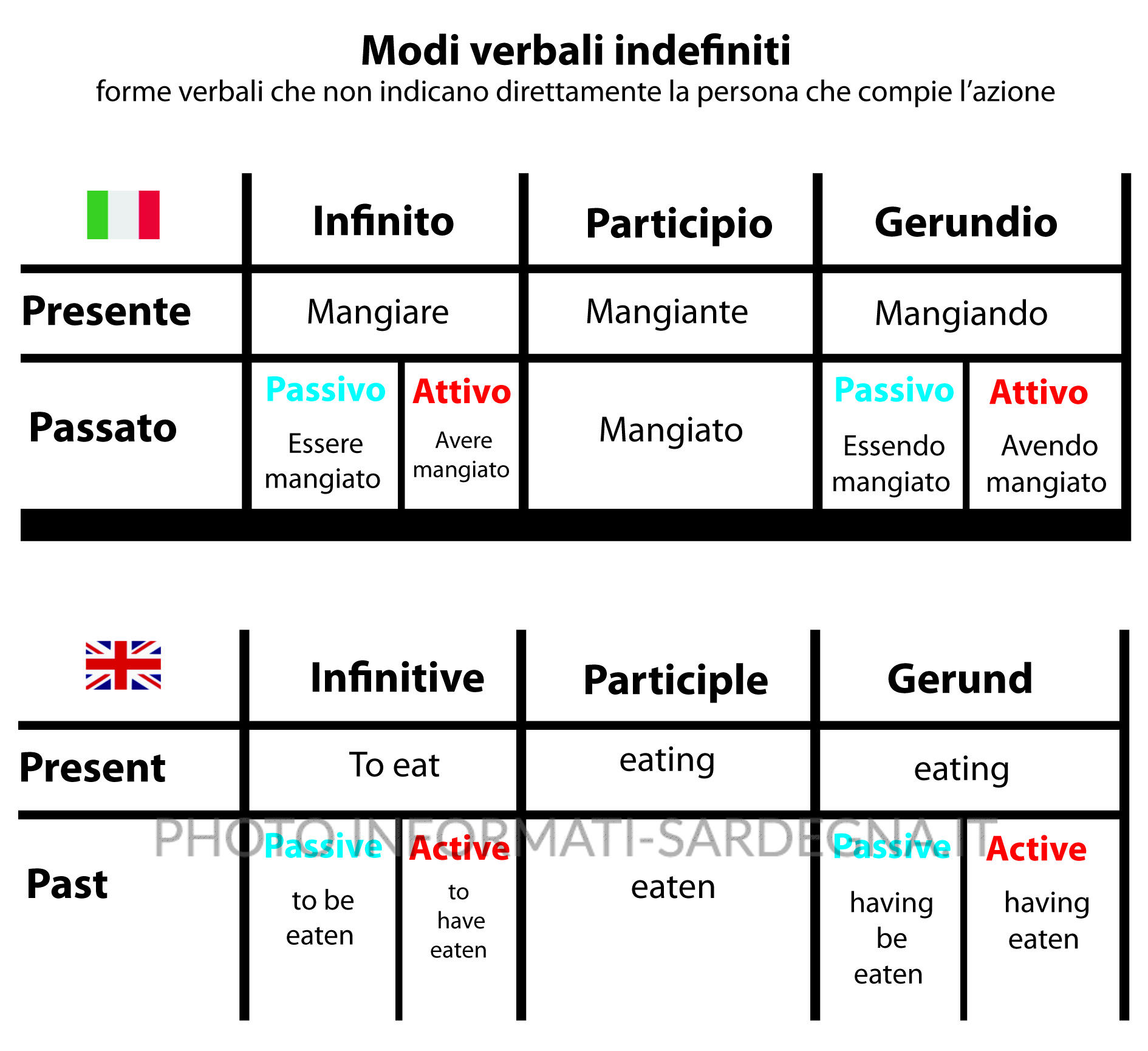
Il gerundio in italiano è un modo verbale indefinito, cioè una forma del verbo che non indica direttamente la persona che compie l’azione.
Viene utilizzato soprattutto per esprimere un’azione collegata a quella della frase principale e può indicare modo, tempo, causa o circostanza.
Il gerundio presente si forma generalmente con le terminazioni -ando per i verbi in -are e -endo per quelli in -ere e -ire: parlare → parlando, leggere → leggendo, dormire → dormendo.
È inoltre utilizzato insieme al verbo stare per formare una costruzione progressiva: “Sto studiando”, “Stava dormendo”.
Il gerundio italiano possiede anche una forma passata, costruita con il gerundio di essere o avere e il participio passato, come in “avendo studiato” o “essendo partito”.
Il gerundio in inglese: cos’è e come si usa
Il gerundio inglese si forma generalmente aggiungendo -ing alla forma base del verbo.
La struttura fondamentale è:
verbo + -ing
Per esempio:
play → playing
study → studying
read → reading
work → working
eat → eating
Questa forma viene spesso chiamata -ing form.
Attenzione, però: la forma in -ing può svolgere funzioni diverse nella frase. Può essere un gerundio, ma viene utilizzata anche per costruire i tempi progressivi, come il Present Continuous.
Confrontiamo:
Swimming is good for you.
Nuotare fa bene.
Qui swimming funziona come gerundio.
I am swimming.
Sto nuotando.
Qui swimming fa parte del Present Continuous.
Quindi non tutte le parole che terminano in -ing svolgono necessariamente la stessa funzione grammaticale.
Come si forma il gerundio inglese
Nella maggior parte dei casi è sufficiente aggiungere -ing.
work → working
play → playing
read → reading
Esistono però alcune regole ortografiche importanti.
Verbi che terminano in -e
Generalmente la -e finale cade prima di aggiungere -ing.
make → making
write → writing
come → coming
dance → dancing
Verbi brevi con consonante finale
In determinati verbi brevi si raddoppia la consonante finale.
run → running
sit → sitting
swim → swimming
stop → stopping
Per esempio:
run → run + n + ing → running
Quando si usa il gerundio
Il gerundio può essere utilizzato come se fosse un nome e può quindi rappresentare un’attività.
Per esempio:
Swimming is fun.
Nuotare è divertente.
Reading is important.
Leggere è importante.
Learning English takes time.
Imparare l’inglese richiede tempo.
Il gerundio viene inoltre utilizzato dopo alcuni verbi.
Tra i più comuni troviamo:
- enjoy
- avoid
- finish
- mind
- suggest
- keep
- consider
Per esempio:
I enjoy reading.
Mi piace leggere.
She finished studying.
Ha finito di studiare.
He avoids driving at night.
Evita di guidare di notte.
TO + INFINITO E + ING FORM
- Want (volere): I want to go. (Voglio andare)
- Decide (decidere): She decided to study. (Ha deciso di studiare)
- Hope (sperare): We hope to win. (Speriamo di vincere)
- Enjoy (piacere/godersi): I enjoy reading. (Mi piace leggere)
- Avoid (evitare): He avoids driving. (Evita di guidare)
- Stop (smettere): Stop talking. (Smetti di parlare)
- Remember to do: Ricordarsi di fare qualcosa nel futuro (Remember to buy milk -> Ricordati di comprare il latte).
- Remember doing: Ricordare un’azione passata (I remember buying milk -> Ricordo di aver comprato il latte).
L’INFINITO
È importante imparare gradualmente quali verbi richiedono to + infinito e quali richiedono invece la forma in -ing.
Confrontiamo:
I want to swim.
Voglio nuotare.
I enjoy swimming.
Mi piace nuotare.
Quindi:
want + to + verbo
ma:
enjoy + verbo-ing
Il presente indicativo in inglese: Present Simple
Il tempo verbale che più direttamente corrisponde al nostro presente indicativo è il Present Simple.
Viene utilizzato soprattutto per parlare di:
- abitudini;
- azioni che si ripetono;
- fatti generalmente veri;
- situazioni relativamente stabili;
- gusti e preferenze;
- orari e programmi prestabiliti.
Per esempio:
I study English every day.
Studio inglese ogni giorno.
Marco lives in Rome.
Marco vive a Roma.
Water boils at 100°C.
L’acqua bolle a 100 °C.
Come si forma il Present Simple
La regola fondamentale è molto semplice.
Con:
I – you – we – they
utilizziamo la forma base del verbo.
Con:
he – she – it
generalmente aggiungiamo -s al verbo.
Prendiamo come esempio to work, lavorare.
| Pronome | Present Simple |
|---|---|
| I | work |
| you | work |
| he | works |
| she | works |
| it | works |
| we | work |
| you | work |
| they | work |
Quindi:
I work.
Io lavoro.
You work.
Tu lavori.
He works.
Lui lavora.
We work.
Noi lavoriamo.
They work.
Loro lavorano.
La differenza fondamentale riguarda quindi la terza persona singolare.
La terza persona singolare: he, she, it
Con he, she e it bisogna prestare particolare attenzione.
Normalmente aggiungiamo:
-s
Per esempio:
play → plays
read → reads
eat → eats
work → works
Verbi che prendono -es
Con alcuni verbi aggiungiamo -es, soprattutto quando terminano in -s, -ss, -sh, -ch, -x, -o.
Per esempio:
watch → watches
wash → washes
go → goes
do → does
fix → fixes
Verbi che terminano in consonante + y
Se il verbo termina con consonante + y, la y diventa i e aggiungiamo -es.
study → studies
try → tries
carry → carries
Per esempio:
I study English.
ma:
She studies English.
Se invece prima della y troviamo una vocale, normalmente aggiungiamo soltanto -s:
play → plays
enjoy → enjoys
La forma negativa del Present Simple
Per costruire la forma negativa utilizziamo:
do not + verbo
oppure:
does not + verbo
Le forme contratte sono:
don’t = do not
doesn’t = does not
Utilizziamo don’t con:
- I
- you
- we
- they
Utilizziamo doesn’t con:
- he
- she
- it
Per esempio:
I don’t work on Sunday.
Non lavoro la domenica.
They don’t study French.
Non studiano francese.
He doesn’t play football.
Lui non gioca a calcio.
Attenzione a una regola fondamentale:
Dopo doesn’t, il verbo torna alla sua forma base.
Quindi:
He doesn’t play. ✅
e non:
He doesn’t plays. ❌
Questo perché la terza persona singolare è già indicata da does.
La forma interrogativa del Present Simple
Per costruire una domanda utilizziamo:
Do + soggetto + verbo?
oppure:
Does + soggetto + verbo?
Per esempio:
Do you speak English?
Parli inglese?
Do they live here?
Vivono qui?
Con la terza persona singolare utilizziamo does:
Does she work here?
Lei lavora qui?
Does Marco study English?
Marco studia inglese?
Anche in questo caso il verbo rimane alla forma base:
Does she work? ✅
non:
Does she works? ❌
Attenzione ai verbi “to be” e “to have”
Due verbi fondamentali sono to be e to have.
Il verbo to be è irregolare:
| Pronome | To be |
|---|---|
| I | am |
| you | are |
| he/she/it | is |
| we | are |
| you | are |
| they | are |
Per esempio:
I am tired.
Sono stanco.
She is happy.
Lei è felice.
They are students.
Sono studenti.
Anche to have presenta una forma particolare alla terza persona singolare:
I have
you have
he/she/it has
we have
they have
Per esempio:
I have a dog.
Ho un cane.
She has a dog.
Lei ha un cane.
Infinito, gerundio e Present Simple a confronto
Vediamo ora le tre forme utilizzando lo stesso verbo, to study.
| Forma | Inglese | Esempio |
|---|---|---|
| Infinito | to study | I want to study. |
| Forma in -ing / gerundio | studying | Studying is important. |
| Present Simple | study/studies | I study every day. |
Un altro esempio con to swim:
| Forma | Inglese | Esempio |
|---|---|---|
| Infinito | to swim | I want to swim. |
| Gerundio | swimming | I like swimming. |
| Present Simple | swim/swims | I swim every Sunday. |
La differenza non riguarda soltanto la forma, ma soprattutto la funzione svolta dal verbo nella frase.
Un esempio completo
Consideriamo queste tre frasi:
I want to play football.
Voglio giocare a calcio.
Playing football is fun.
Giocare a calcio è divertente.
I play football every Saturday.
Gioco a calcio ogni sabato.
In tutte e tre le frasi compare il verbo play, ma in forme e funzioni differenti:
- to play → infinito;
- playing → gerundio;
- play → Present Simple.
Questa distinzione è fondamentale per comprendere il funzionamento dei verbi inglesi.
Errori comuni da evitare
Uno degli errori più frequenti riguarda la -s della terza persona singolare:
He play football. ❌
He plays football. ✅
Un altro errore riguarda l’uso di does:
Does she studies English? ❌
Does she study English? ✅
Oppure:
She doesn’t likes pizza. ❌
She doesn’t like pizza. ✅
Ricordiamo quindi questa regola:
Dopo do, does, don’t e doesn’t utilizziamo la forma base del verbo.
Schema riassuntivo
Per ricordare facilmente quanto studiato possiamo utilizzare questo schema:
| Forma verbale | Struttura | Esempio |
|---|---|---|
| Infinito con to | to + verbo | to work |
| Infinito senza to | verbo base | can work |
| Gerundio | verbo + ing | working |
| Present Simple I/you/we/they | verbo base | work |
| Present Simple he/she/it | verbo + s/es | works |
| Negativa | don’t/doesn’t + verbo | doesn’t work |
| Interrogativa | Do/Does + soggetto + verbo | Does he work? |
Esercizi
Esercizio 1 – Scrivi l’infinito e il gerundio
Completa la tabella.
| Verbo | Infinito | Gerundio |
|---|---|---|
| play | ………… | ………… |
| study | ………… | ………… |
| run | ………… | ………… |
| write | ………… | ………… |
| swim | ………… | ………… |
Esercizio 2 – Completa con il Present Simple
- I ………… (play) football every Saturday.
- She ………… (study) English every day.
- They ………… (live) in London.
- Marco ………… (work) in a restaurant.
- We ………… (watch) television in the evening.
- Susan ………… (go) to school by bus.
- My brother ………… (play) tennis.
- You ………… (speak) English very well.
Esercizio 3 – Trasforma nella forma negativa
- I play tennis. → ………………………………….
- She works here. → ………………………………….
- They study English. → ………………………………….
- He lives in London. → ………………………………….
- We like pizza. → ………………………………….
Esercizio 4 – Trasforma in domanda
- You speak English. → ………………………………….?
- She plays tennis. → ………………………………….?
- They live in Rome. → ………………………………….?
- Marco studies English. → ………………………………….?
- You work here. → ………………………………….?
Esercizio 5 – Infinito o gerundio?
Inserisci la forma corretta del verbo indicato.
- I want ………… English. (study)
- She enjoys ………… books. (read)
- We decided ………… home. (go)
- He likes ………… football. (play)
- They want ………… in London. (live)
- She finished ………… her homework. (do)
Conclusione
Studiare infinito, gerundio e presente indicativo in inglese permette di costruire le basi necessarie per affrontare forme verbali più complesse.
L’infinito presenta generalmente la struttura to + verbo, come to study; il gerundio utilizza la forma in -ing, come studying; il Present Simple, invece, utilizza normalmente la forma base del verbo, aggiungendo -s o -es alla terza persona singolare.
Imparare queste strutture e utilizzarle all’interno di frasi semplici aiuta a comprendere progressivamente il funzionamento della grammatica inglese e prepara allo studio dei tempi verbali successivi, come il Present Continuous, il Past Simple e il Present Perfect.
Traduzioni dall’Italiano
- Mangio un uovo al mattino
- I eat an egg in the morning
- Anche Susan mangia un uovo al mattino
- Also Susan eats an egg in the morning
- Noi mangiamo pancetta e uova
- We eat bacon and egg
- Io bevo te al mattino
- I drink tea in the morning
- Noi beviamo caffè al mattino
- We drink coffee in the morning
- La Signora Brown mangia un panino al mattino
- Mrs Brown eat a sandwich in the morning
- Il Signor Brown beve caffè
- Mr Brown drinks a coffee
- Noi studiamo di sera
- We study in the evening
- John scrive lettere di sera
- John writes letters in the evening
- Tom legge un libro inglese di sera
- Tom reads one engish book in the evening
- La Signora Brown parla con il Signor Brown di sera
- Mrs Brown talks with Mr Brown in the evening
- Noi beviamo tè nel pomeriggio
- We eat tea in the afternoon
- Susan beve un caffè nel pomeriggio
- Susan drinks one coffee in the afternoon
- Noi studiamo per imparare l’inglese
- We study for to learn the english
- Spero di imparare l’inglese
- I hope to learn the english
- Preferisco leggere un libro italiano
- I prefer to read an italian book
- Siamo qui a trovare Susan
- We are here to visit Suan
- Studio inglese ora
- I study english now
- Leggo un libro inglese
- I read an english book
- Parlo con Tom ora
- I talk with Tom now
- John parla con il Signor Brown
- John talks with Mr Brown
- La Signora Brown beve te
- Mrs Brown drinks the tea
- Susan e Tom parlano
- Susan and Tom talks
- Giocano con una palla
- They play with one ball
- Scriviamo una lettera
- We write one letter
- Essi leggono ora
- They read now
- La Signora Brown è seduta su una sedia
- Mrs Brown is sitting on a chair
- Il Signor Brown è in piedi vicino alla finestra
- Mr Brown is standing near the windows
- Pussy è steso sul pavimento
- Pusy is lying on the floor
- Susan mangia un panino ora
- Susan eats a sandwich now
- John beve un tè ora
- John drinks a tea now
- Ognuno fa colazione ora
- Everyone has a breakfast now
- Il Signor Brown legge una lettera ora
- Mr Brown reads a letter now
- Susan e John parlano ora
- Susan and John talks now
- Mister Brown scrive una lettera ora
- Mr Brown writes one letter now
- Susan studia ora
- Susan study now
Correzioni
- 🔵 Anche Susan mangia un uovo al mattino
❌ Also Susan eats an egg in the morning
✅ Susan also eats an egg in the morning.
→ Also è più naturale prima del verbo principale. - 🔵 Noi mangiamo pancetta e uova
❌ We eat bacon and egg
✅ We eat bacon and eggs.
→ Si usa normalmente eggs al plurale. - 🔵 La Signora Brown mangia un panino al mattino
❌ Mrs Brown eat a sandwich in the morning
✅ Mrs Brown eats a sandwich in the morning.
→ Alla terza persona singolare: eat → eats. - 🔵 Il Signor Brown beve caffè
⚠️ Mr Brown drinks a coffee
✅ Mr Brown drinks coffee.
→ Se parliamo del caffè in generale, non si usa l’articolo. - 🔵 Tom legge un libro inglese di sera
❌ Tom reads one english book in the evening
✅ Tom reads an English book in the evening.
→ Si usa an, non one. Inoltre English vuole la maiuscola. - 🔵 La Signora Brown parla con il Signor Brown di sera
⚠️ Mrs Brown talks with Mr Brown in the evening
✅ Mrs Brown talks to Mr Brown in the evening.
→ Talk with è possibile, ma talk to è più naturale qui. - 🔵 Noi beviamo tè nel pomeriggio
❌ We eat tea in the afternoon
✅ We drink tea in the afternoon.
→ Il tè si drinks, non si eats. - 🔵 Susan beve un caffè nel pomeriggio
❌ Susan drinks one coffee in the afternoon
✅ Susan drinks a coffee in the afternoon.
→ One coffee sottolineerebbe il numero; normalmente si usa a coffee. - 🔵 Noi studiamo per imparare l’inglese
❌ We study for to learn the English
✅ We study to learn English.
→ Per indicare lo scopo: to + verbo. Non for to. Inoltre English non vuole the. - 🔵 Spero di imparare l’inglese
❌ I hope to learn the English
✅ I hope to learn English.
→ I nomi delle lingue normalmente non vogliono l’articolo. - 🔵 Preferisco leggere un libro italiano
❌ I prefer to read an italian book
✅ I prefer to read an Italian book.
→ Le nazionalità e gli aggettivi geografici vogliono la maiuscola: Italian. - 🔵 Siamo qui a trovare Susan
❌ We are here to visit Susan
✅ We are here to visit Susan.
→ Errore di battitura: Suan → Susan. - 🔵 Studio inglese ora
⚠️ I study English now
✅ I am studying English now.
→ Se l’azione avviene in questo momento, si usa il Present Continuous. - 🔵 Leggo un libro inglese
⚠️ I read an English book
✅ I am reading an English book. (se lo sto leggendo in questo momento)
→ Per un’azione in corso si usa il Present Continuous. - 🔵 Parlo con Tom ora
⚠️ I talk with Tom now
✅ I am talking to Tom now.
→ Now indica un’azione in corso → Present Continuous. - 🔵 La Signora Brown beve tè
❌ Mrs Brown drinks the tea
✅ Mrs Brown drinks tea.
→ Se parliamo genericamente del tè, non si usa the. - 🔵 Susan e Tom parlano
❌ Susan and Tom talks
✅ Susan and Tom talk.
→ Il soggetto è plurale → talk, non talks. - 🔵 Giocano con una palla
⚠️ They play with one ball
✅ They play with a ball.
→ A ball = una palla. One ball sottolinea il numero “una sola”. - 🔵 Scriviamo una lettera
⚠️ We write one letter
✅ We write a letter.
→ Normalmente “una lettera” = a letter. - 🔵 Essi leggono ora
⚠️ They read now
✅ They are reading now.
→ Azione che sta avvenendo ora → Present Continuous. - 🔵 Il Signor Brown è in piedi vicino alla finestra
❌ Mr Brown is standing near the windows
✅ Mr Brown is standing near the window.
→ Finestra è singolare → window. - 🔵 Pussy è steso sul pavimento
❌ Pusy is lying on the floor
✅ Pussy is lying on the floor.
→ Errore di battitura nel nome. - 🔵 Susan mangia un panino ora
⚠️ Susan eats a sandwich now
✅ Susan is eating a sandwich now.
→ Azione in corso → Present Continuous. - 🔵 John beve un tè ora
⚠️ John drinks a tea now
✅ John is drinking tea now.
→ Azione in corso → is drinking. In senso generico, tea non richiede l’articolo. - 🔵 Ognuno fa colazione ora
❌ Everyone has a breakfast now
✅ Everyone is having breakfast now → Present Continuous.
→ Si dice have breakfast, senza articolo. Con now → is having. - 🔵 Il Signor Brown legge una lettera ora
⚠️ Mr Brown reads a letter now
✅ Mr Brown is reading a letter now.
→ Azione in corso → Present Continuous. - 🔵 Susan e John parlano ora
❌ Susan and John talks now
✅ Susan and John are talking now.
→ Soggetto plurale + azione in corso → are talking. - 🔵 Mister Brown scrive una lettera ora
❌ Mr Brown writes one letter now
✅ Mr Brown is writing a letter now.
→ Is writing perché l’azione avviene ora; a letter, non one letter. - 🔵 Susan studia ora
❌ Susan study now
✅ Susan is studying now.
→ Con now, se sta studiando in questo momento, si usa il Present Continuous.
Il punto principale da consolidare non è tanto il vocabolario, quanto la distinzione tra Present Simple e Present Continuous:
Present Simple → abitudine
- Susan eats a sandwich every morning. = Susan mangia un panino ogni mattina.
Present Continuous → azione che sta accadendo ora
- Susan is eating a sandwich now. = Susan sta mangiando/mangia un panino ora.
Questa distinzione spiega buona parte degli errori dell’ultima parte dell’esercizio.
Vocabolario
- Panino imbottito = sandwich
- Preferire = to prefer
- Sdraiarsi = to lay down
- Guarda anche: il Gerundio in inglese con Kaplan